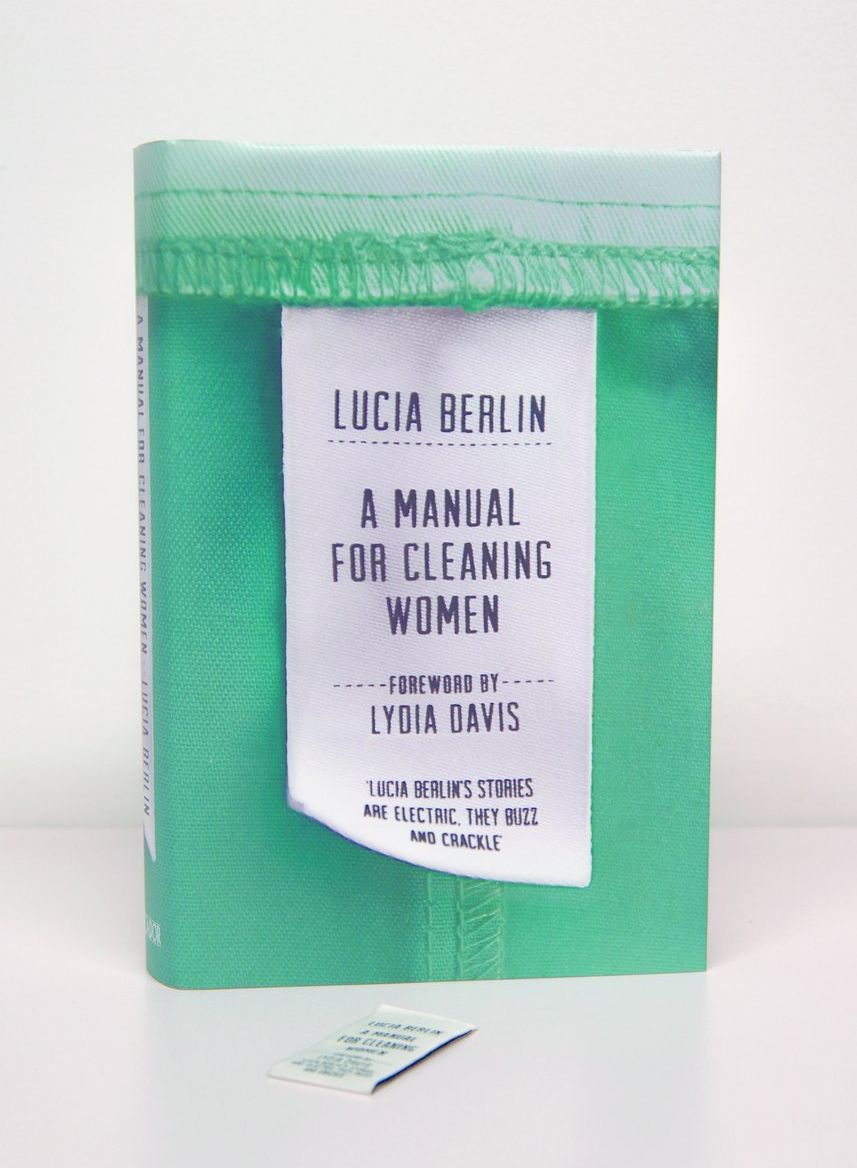
The first work I read by Lucia Berlin was the 2018 collection Evening in Paradise. I read it the summer after its release and I fell in love; with her narrators, her places, her language, her voice. Falling in love seems an apropos response to a writer whose work arises from an almost innocent belief in connectivity, both subconscious and actively pursued, between people. A Manual for Cleaning Women, also posthumously published, came out in 2015 and is the short story collection that placed Berlin in a long deserved spotlight. While the collection is more expansive than Evening in Paradise, her voice is still the one I fell in love with that summer day. In these stories, she pushes the boundaries of bio-fictive settings and characters while still searching for the truth of why people are drawn to each other. Even as she wanders across space, time, and genre, exploring meta-fictive dialogue or first-person, male narrators (a refreshing switch in POV I feel she handled well), the reader remains grounded in the intimacy of connectivity at the center of every story. What happens to a single character feels both infinitesimally personal, theirs and theirs alone, while at the same time encompasses the experiences of the whole of humankind. Grief, addiction, romance, abuse, neglect, hope, joy, and always, beyond all else, love—these are the stories that Lucia Berlin seeks to tell.

For me, the first story of this collection was all I needed to know this book would become a favorite. “Angel’s Laundromat” brought me right back to my first encounter with Berlin; sprawled across my bed, sun pouring in, I moved slowly but steadily through the world of Evening in Paradise and found myself in her world, figuratively but also literally. Here is the sense of recognition I have felt with the stranger at the stadium who always seems to be running the steps at the same time as me or the barista who knows my order but not my name. The narrator’s conversation with “the Indian” in the laundromat seems to skip introductions and move right into familiarity, which it should because their hands shake in the same way and for the same reason. When Tony watches her take out a cigarette before he offers to light it for her, the silence around this action poses a question to the reader: is he silent because he is being polite or because he already knows what is happening, that a lack of alcohol in her system means her hands are shaking too much to both hold the cigarette and light it. It’s the latter but the narrator feels no need to state the obvious. Instead, she shows us what fills the seemingly chair that Tony and her always leave between them as they sit in the laundry mat, waiting.
She recalls a time she silently loaded Tony’s washing machine with a palmful of dimes he held out to her. His limbs shook too much too handle such a small task, the liquor in his system making him weave as he stood behind her asking for her help without saying a word. There is no need to state what they both already know about each other and about themselves. Looking at their reflections in the mirror across from their seats “we smiled at each other,” she says, “[we] were very close and then he passed out and I was alone in the mirror” (7). Together but alone, the experience of the functioning alcoholic always teetering on the edge of able and unable.

With this first story the reader is dropped into the presentness of Berlin’s writing, the immediacy of her narrative is not pressing it is simply of the moment. She does not try to hide her characters’ flaws, they are always there and so they do not have to be stated to be seen. The narrator of “Angel’s Laundromat” seems to resist admitting that Tony is not just a “tall old Indian in faded Levi’s and a fine Zuni belt” that she sometimes sees washing clothes (3). That description alone, the detail of it, tells a reader there is more to it than that. Slowly, the narrator gives us bits and pieces, little details about who she is, never more than a few words, which let the reader know why she is so resistant to remembering Tony as anything more than a stranger. This is the sort of life that has become familiar to the narrator. It is lonely, isolated, it is full of insecurity—financial and emotional—there is no home, not a reliable one, not one you can go back to year after year. Alcoholism is constantly taking away; blackouts take memories, prison and rehab take time, dying takes people. To hold onto Tony, to acknowledge him as someone she knew, cared about, means acknowledging that he was taken away, opening herself to the grief and pain of yet another loss. So instead, he is the tall, old Indian at Angel’s laundromat. Instead Berlin’s story lets us feel their connection in the subtle opening up of the narrator remembering Tony. She can remember the time he put his hand on her shoulder, silently handing her three dimes; how she realized that he was not giving her money but asking her to help him. Without words he asks and she understands that he is “shaky-sick” and needs help putting change into the washing machine. “Sober, it’s hard,” she tells us and carefully describes the step by step process of putting money into the machine when you are trembling with alcohol or lack thereof (4). She is showing the reader that she knows what he is asking, knows how hard it is, because she has struggled with this same task. Eventually, the space between them shrinks and they sit in their plastic chairs, side-by-side, clasping each others hands. Aged, scarred, shaking, their hands hold each other’s stories, not tenderly but with humor and empathy. In the end the narrator says she cannot remember when the old Indian stopped showing up and with that she lets him go, lets his name and story go, so that she can hold onto tomorrow.
“Perhaps it’s the realization that losing someone doesn’t have to mean they’re lost to you”
Buried in the middle of “Angel’s Laundromat” is a line which could arguably explain everything Berlin writes: “Anybody says he knows just how someone else feels is a fool” (5). Berlin does not seek to explain everyone else. Her narrators do not presume to be all knowing, instead they seek to know themselves. They are stand-ins for the reader, for those that cannot put words to their experiences. Ironically, in not trying to claim ultimate understanding Berlin manages to accomplish something close to that; she crafts a narrative journey which connects the intimate reality of one person to the underlying emotional states so often at the root of others’ identities. In one of the last stories of the collection, “B.F. and Me,” another connection like the the one in “Angel’s Laundromat” occurs, only this time the narrator doesn’t shy away from it. Perhaps it’s time and age, perhaps it’s healing as well as the sense of an impending end, or perhaps it’s the realization that losing someone doesn’t have to mean they’re lost to you nor that you’ve lost a piece of yourself. In this story the narrator announces that from the first moment she encountered B.F. she felt drawn to him. In the opening line she tells the reader that after hearing his voice on the phone, “I liked him right away” (376). And she repeats this again after meeting him in person, the exact same line, “I liked him right away” (377).
Like the old Indian, B.F.’s appearance is not the type to strike a person as beautiful or full of life. He is clearly someone that drinks too much, smokes too much, and eats too much⏤and has always done so. He struggles to move about, is unreliable when it comes to showing up when he says he will, and does not hold his punches when it comes to telling a customer the blunt truth. Which suits the narrator just fine. She relies on an oxygen tank to breathe, lives in an old trailer-home, and very comfortably describes herself as “a strong woman, even mean” (377). She is not interested in being what she is not and she sees this in B.F. as well. The two of them take their time moving through her trailer, gasping for air and leaning heavily on anything that can take their weight (379). She is blunt about her leaky bladder and he lights up a cigarette as soon as he finishes his inspection. And yet for the narrator, B.F.’s bloodshot baby-blue eyes hold a smile and his voice, raspy and easygoing, carries humor and a sensual appeal (377, 376). When he doesn’t show up to tile her bathroom when he said he would, she doesn’t get angry. The narrator isn’t in a rush, not like she might have been when she was younger. Instead, B.F. calls her one day out of the blue (she doesn’t tell us how long has passed) and asks if he can stop by tomorrow. She says sure, that he can stop by “any time” (379). Maybe it’s love, maybe it’s amusement, or maybe it’s simply that she sees a piece of her story reflected in B.F.’s eyes and voice. This is the point: that stories are meant to move through those that came before you, through those around you, and through you. Stories are not so much a retelling as they are a carrying over. And the narrator knows that the time is coming for the story of life to take what it can from her and move on to someone else.
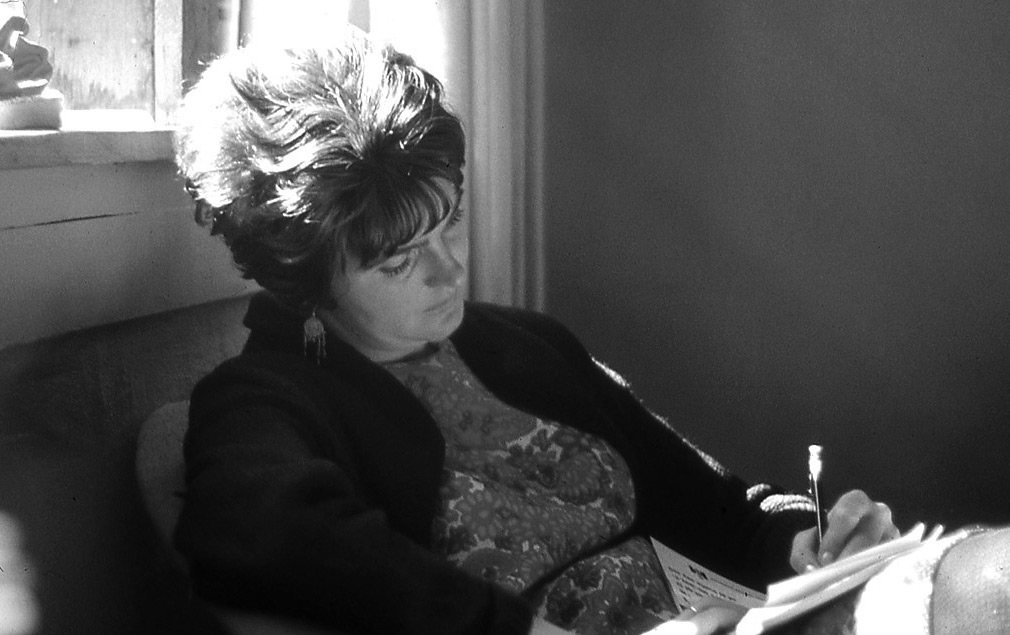
In Dale Smith’s review of A Manual for Brick Magazine, he writes that Berlin’s “warm and deliberate style refuses nostalgia; she exerts no longing for what she has missed, what could have been.” I find that I both agree and also disagree. I think nostalgia is central to her stories in the sense that Berlin appreciates what has happened to herself and to those she encounters that has brought them to wherever they are at the moment. However, she doesn’t hold on to these happenings; she isn’t overly sentimental and she doesn’t resent. Instead she acknowledges her past—treasures the moments of love and laughter and pain and struggle—as a part of her being. Instead of becoming spectors haunting a Cimmerian past, memories are a constantly growing chain of present moments. Like leaves on an ivy vine, each one is alive and faintly glimmering.
“Have faith, she seems to say, with every breath have faith in yourself and what you feel”
These stories are Berlin’s own stories and she is not shy about making clear that her stories are bio-fictive constructions, a mixture of imagination and memory meant to recall reality. “Silence” is a meta-fictive rumination that provides insight into why and how she pieces her imaginings and her life together to write a story. While the narration is more experimental, the story is still told with her gentle touch and clear-eyed honesty. Berlin addresses her reader directly and in a familiar tone as she references other stories she has written in an almost off hand way*. The relationship between the reader and her, as narrator and as writer, is understood to have become familiar because the reader knows her now, her dark moments and her light, through her stories. Yes, she writes fiction but that does not mean that what she writes is not real. Berlin tells us through her narrator that “I exaggerate a lot and I get fiction and reality mixed up, but I don’t actually ever lie” (325). This is at the heart of storytelling, at the heart of her storytelling especially; the emotions she shares that connect with your own, the love that flows through her characters—siblings, children and parents, lovers, friends, neighbors, strangers—is real, it exists, it happened and continues to happen, will always happen. Berlin finds continuity in the uncertainty of an outsider’s life, a universality that arcs through gender, class, nationality and age. Have faith, she seems to say, with every breath have faith in yourself and what you feel.
*Note: “I have told you about Sammy” she reminds us (324), referencing other stories including “The Musical Vanity Boxes” which can be found in Evening in Paradise.
Sources
Berlin, Lucia. A Manual for Cleaning Women, Farrar, Straus and Giroux, 2015.
Berlin, Lucia. Evening in Paradise, Farrar, Straus and Giroux, 2018, pp. 3-19.
Smith, Dale. “The Review: A Manual for Cleaning Women by Lucia Berlin.” Brick: A Literary Journal, 2 Mar. 2017, brickmag.com/a-manual-for-cleaning-women-by-lucia-berlin/.

