My junior year of undergrad, I had the chance to study abroad in Nepal. My college had set up a small schoolhouse outside the capital city of Kathmandu in the 1960s and ever since had run a program with the support of local, Nepalese families, guides, and teachers for going on 5 generations. That semester, the group I was a part of turned out to be highly unusual, the first of its kind as far as anyone knew: we were all female. There was just 8 of us (also the smallest group of students to make up a program), all girls and all the same age.
Despite what common media of the time might have had us believe, these two factors⏤young and female⏤did not mean we were alike. Sitting down for introductions that first night in Nepal, we were like the toys left in a kindergarten classroom at the end of a very long, school year: a collection of incongruous and unrelated curios that looked (and felt) a little worse for wear after the 24 hours we had just spent on planes and in airports traveling across the world. To be blunt, we were different from top to bottom, from the foods we ate (from a vegan whose sugar-free, dairy free chai requests bemused her host family to the girl who ate anything handed to her including goat’s tongue and boiled snails) to the number of times we showered (from every morning to once every month…or so). These were the superficial ways we differed, the things we were only just beginning to decide for ourselves as the title of “adult” began to settle on our shoulders like a coat we had been waiting to grow into. We different in those deeper ways, the sort of ways that had been decided for us long before we had even existed. Where were our grandparents born, our parents, us? What languages did we speak at home? What sort of schools did we attend and what sort of places had we called home?
Some of us were First Generation Americans, some of us came from families who had been “White” for generations, some of us were biracial, some of us were queer, some of us didn’t speak English at home, some of use had gone to private schools, some of us had been homeschooled, some of us had grown up in the suburbs, some of us had never had our own room, some of us had studied classical piano, some of us had learned to ride dirt bikes, some of us had spent summers in Europe while some of use had never left home before coming to Nepal.
According to American pop culture it should have been a disaster. We should have been at each other’s throats, rolling eyes and forming cliques. But that isn’t the true potential of female friendships. The truth is, the closeness we 8 girls came to feel was joyful, open, and caring. The time I spent with those girls taught me that I was enough. With a true friend, who I am will always be more than enough.
“They sky clouded over some more, but Poornima looked into the horizon and thought she could see to the ends of the earth, its curving unto itself, feminine and aching.”
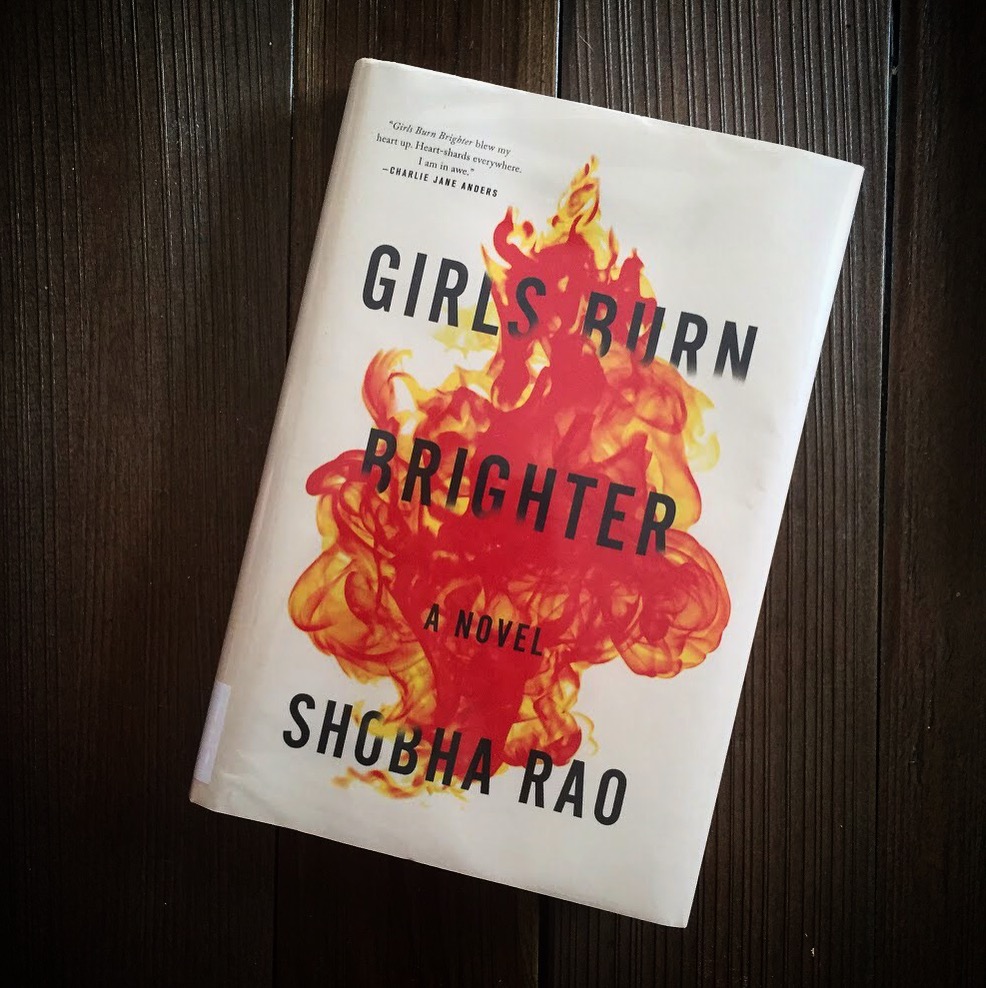
Having had the chance to experience what happened in just 6 months amongst a group of American girls who were still connected to the “outside world” through internet cafes and Skype calls, I fell head first into the friendship that forms between Shobha Rao‘s heroines. And heroines they most definitely are; Poornima and Savitha are light-filled girls who learn to keep their inner fire burning despite the horrific abuse of those who have no use for them except as empty vessels. The fire that Rao describes burning within the girls is private, or rather it is intimate, only they can see it themselves and each other, but they learn that this intimacy is more than enough. The fires inside of them are not for the admiration of those around them, if they were, then these fires would have been quickly extinguished (and we would have no story, a true tragedy). Instead, the girls choose to believe that it is possible for them to have a life that is fully their own, one which is forged by their inner fire instead of forced into the cavity left behind when a girl’s will-to-aspire is extinguished. They come to realize a life of their own making is possible by caring for each other. Theirs is the first relationship where they receive without asking and give without demand; there is no sense of duty or fear between them. And so they become a part of each other’s fire and help it burn brighter.
Following Poornima and Savitha as they search for each other is like watching a child reach for the moon and actually touch it. It feels both hopeless and hopeful, as if you want to believe in something you know is impossible because if somehow it happens, if somehow that child reaches the moon, if somehow these girls find each other across the years and oceans that separate them, then maybe this world isn’t so terrible after all.
That being said, this story is not an easy read and I feel it necessary to make this clear. There are horrific descriptions of events made only more horrific because they are real for women all over the world. The U.S. government estimates that between 14,500 to 17,500 people are trafficked into the U.S. alone. This does not include the number of enslaved people who already reside in the U.S.* The majority of trafficked peoples are girls and women, with the primary reason being sexual enslavement followed by domestic labor. The abuse and trafficking of girls is at the heart of this story and Rao is very precise in her portrayal of the many ways in which women are gruesomely used. She is also thorough in her mining the depth of emotions that come from such treatment, and does a very good job of leveraging the reactions of others to the physical affects the abuse leaves on the girls bodies. In describing others’ reactions to these girls, and how others’ behaviors towards the girls changes with each new piece of physical evidence of abuse, Rao delves into the social climate of abuse as well as the long-term emotional affect such trauma creates in its survivors.
In the end, Poornima and Savitha do not survive because they are rescued by a Prince Charming, a Doting Father-figure, or a White Benefactor. They survive in spite of these figures’ greatest attempts to empty them and use them. These girls save themselves and they save each other, and it is a powerful thing to read.
* Note: Data varies greatly. The numbers I’ve provided are from the ACLU, who cite the U.S. Department of State as the original source.
 Teresa Diviacchi